
Education Center
Diamond Anatomy
While every diamond is unique, all diamonds share certain structural features that contribute to their overall beauty and brilliance. A diamond’s anatomy, or its basic structure, plays a crucial role in determining its proportions, brilliance, dispersion, and scintillation. Understanding these structural components and how they interact can significantly enhance your appreciation of a diamond’s craftsmanship and quality. Each part of a diamond has a specific name and function, and having a basic understanding of these elements will help you find your perfect diamond.
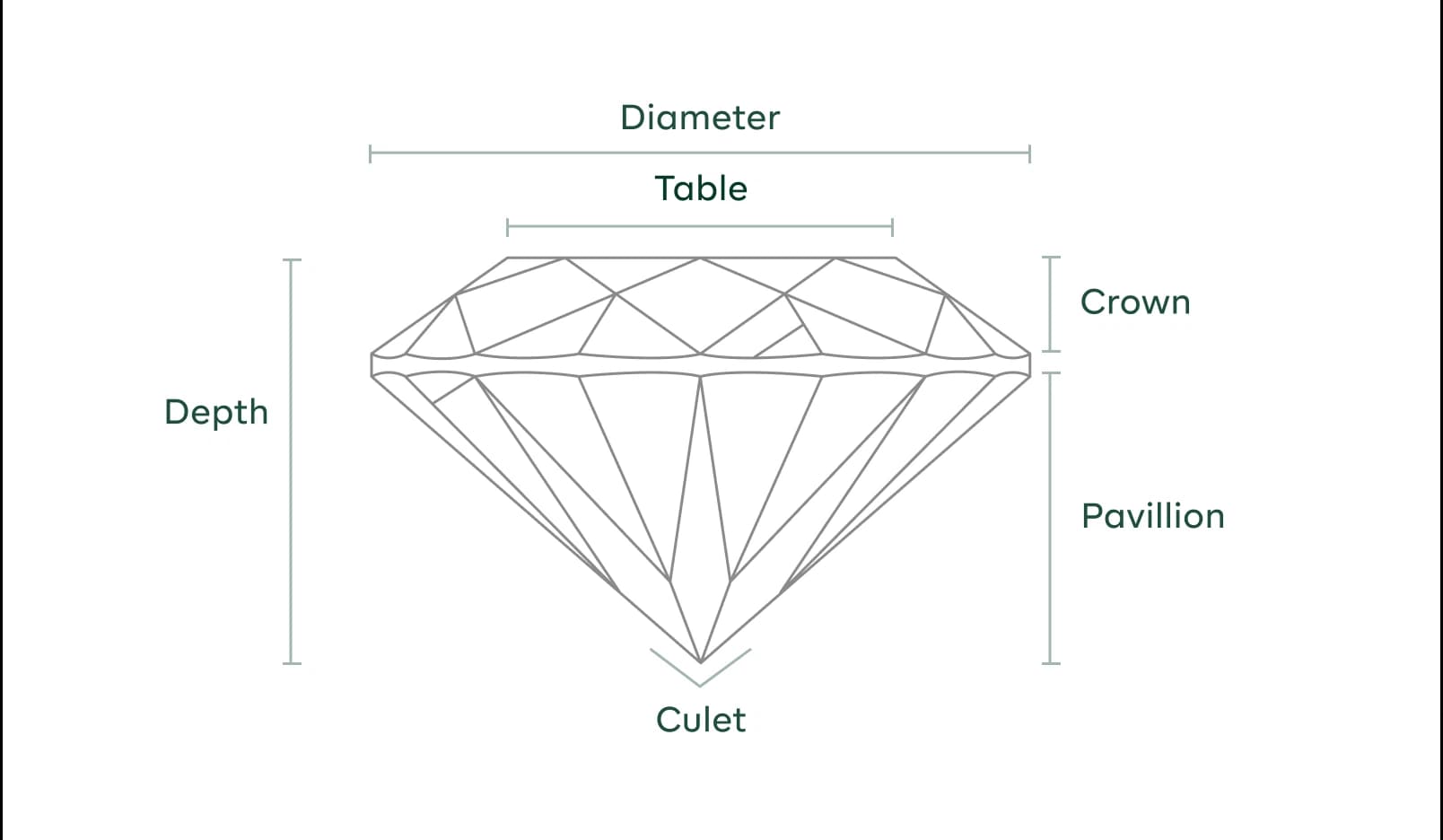
A diamond is comprised of eight main components, each contributing to its overall appearance and performance. These components are the Diameter, Table, Crown, Table Spread, Girdle, Pavilion, Depth, and Culet. Here is a detailed description of each part of a diamond and its location:
While every diamond is unique, all diamonds share certain structural features that contribute to their overall beauty and brilliance. A diamond’s anatomy, or its basic structure, plays a crucial role in determining its proportions, brilliance, dispersion, and scintillation. Understanding these structural components and how they interact can significantly enhance your appreciation of a diamond’s craftsmanship and quality. Each part of a diamond has a specific name and function, and having a basic understanding of these elements will help you find your perfect diamond.
A diamond is comprised of eight main components, each contributing to its overall appearance and performance. These components are the Diameter, Table, Crown, Table Spread, Girdle, Pavilion, Depth, and Culet. Here is a detailed description of each part of a diamond and its location:
Diameter
The width of a polished stone, measured from edge to edge.
Diameter
The width of a polished stone, measured from edge to edge.
Table
The largest polished facet located on the top of the diamond.
Table
The largest polished facet located on the top of the diamond.
Crown
The top part of a diamond extending from the table to the girdle. The crown is made up of bezel facets (crown mains), star facets, upper girdle facets (upper halves), and a table facet.
Crown
The top part of a diamond extending from the table to the girdle. The crown is made up of bezel facets (crown mains), star facets, upper girdle facets (upper halves), and a table facet.
Gridle
The very edge (widest edge) of the diamond where the crown and pavilion meet.
Gridle
The very edge (widest edge) of the diamond where the crown and pavilion meet.
Pavilion
The bottom part of a diamond extending from the girdle down to the culet.
Pavilion
The bottom part of a diamond extending from the girdle down to the culet.
Depth
The total height of a diamond measured from the table to the culet.
Depth
The total height of a diamond measured from the table to the culet.
Culet
The small or pointed facet at the very bottom of the diamond.
Before purchasing a diamond, make sure that you have a basic understanding of a diamond’s anatomy. This will allow you to truly appreciate diamonds and all their intricacies, communicate with experts about a particular diamond, and, most importantly, it will assist you in making a well-thought out decision about which diamond is best for you.Culet
The small or pointed facet at the very bottom of the diamond.
Before purchasing a diamond, make sure that you have a basic understanding of a diamond’s anatomy. This will allow you to truly appreciate diamonds and all their intricacies, communicate with experts about a particular diamond, and, most importantly, it will assist you in making a well-thought out decision about which diamond is best for you.